
There is a phrase that Allen Taylor did not invent.
He spotted it on a youth basketball jersey at an AAU tournament years into his teaching career. Four words on a shirt that stopped him in his tracks — because they perfectly described everything he had already been doing for years without a name for it.
Reach One. Teach One.
Give me twenty-four students. If I can reach just one — that one might change a community. That one might change the world.
That is how Allen Taylor has shown up for nearly thirty years. And it is exactly why his students still stop him in grocery stores years later and say — Coach T, you were right.
Allen Taylor was not destined for teaching. Not by anyone's prediction.
He grew up in the projects, moved across multiple schools, and arrived in Loyalsock — a more affluent area where the academic expectations far exceeded anything he had encountered before. He had an undiagnosed reading disability that nobody identified until community college. He was burned out by senior year. He took time off and by his own admission was making very poor choices.
But two women refused to give up on him.
Miss Mealy — his senior year math teacher — would not let him skip the word problems. She told him he was too smart for that. At some point Allen looked at her and asked — do you think I could be a teacher?
She said absolutely. And she meant it.
What Allen did not know at the time was that Miss Mealy and Mrs. Nancy Bowers — his math instructor at Pennsylvania College of Technology — were close friends. Both women independently refused to let him sell himself short. Mrs. Bowers talked him into tutoring other students. And the moment a struggling student finally understood something — that light bulb coming on — Allen Taylor found his calling.
"God had a plan. He put those people in my life for a reason."
Black male teachers make up less than 2% of the K-12 teaching workforce in the United States — and that number is declining not growing.
Allen knows this number well. He is a math teacher after all.
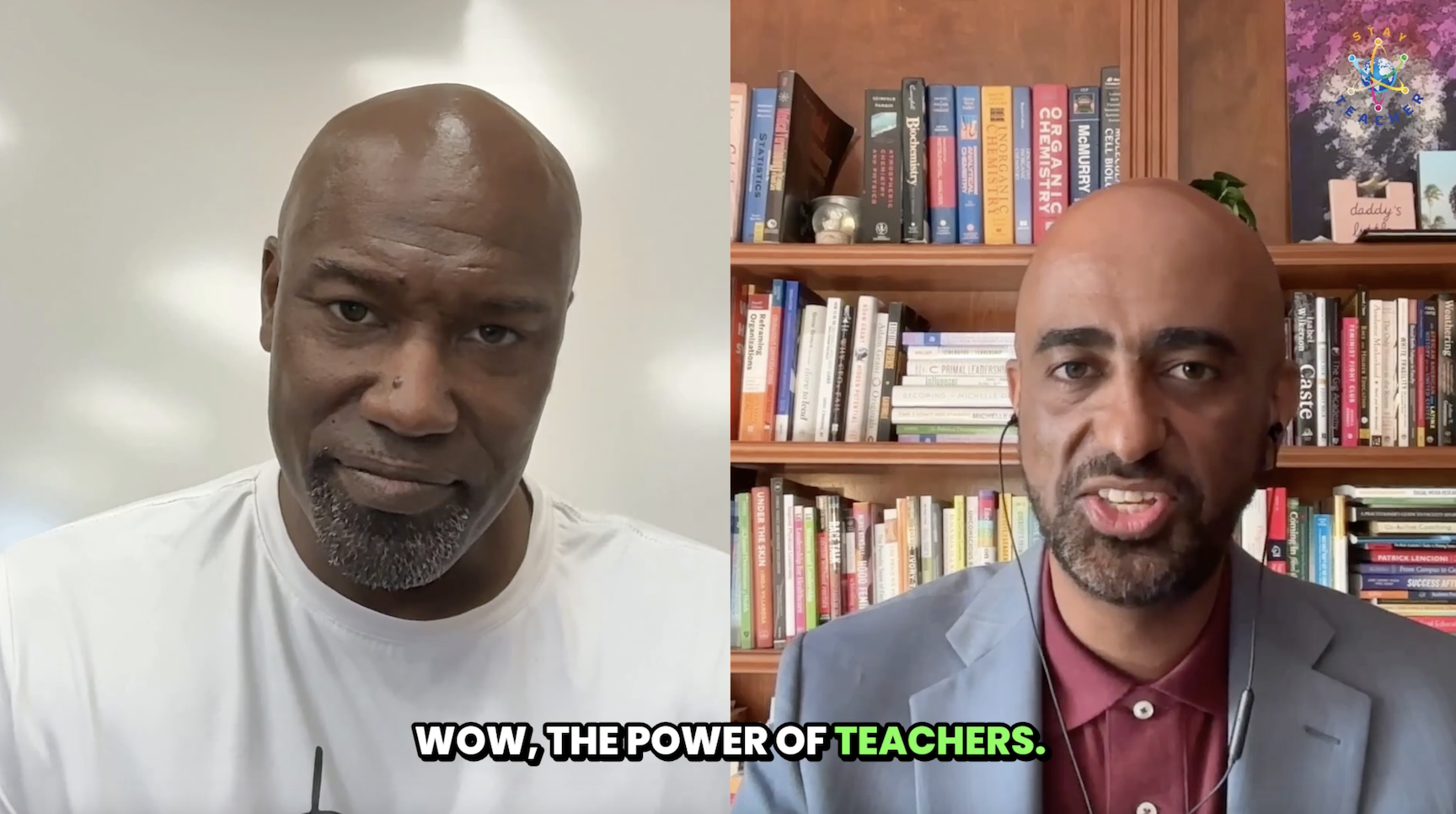
When Coach G asked him what happens when a Black student walks into his classroom and sees him standing there — Allen's answer was immediate.
"They thought maybe I was an intervention or a volunteer. You're the math teacher? And then there's just a big smile on their face."
That smile — before a single lesson is taught — is what representation looks like. And in a country where less than 2% of teachers are Black men that smile is far too rare.
Allen was asked to share a specific student whose life he helped change.
He told the story of a young man on his freshman basketball team. Terrible attendance. GPA below 1.5. No real support system at home.
Then in his sophomore year the student woke up one morning and his mother died.
Allen and a network of mentors and church community members rallied around this young man. They kept him in school. They helped him build his grades — one semester at a time — from below a 1.5 all the way to a 3.7. By his senior year he had earned a full ride basketball scholarship and went on to be all-conference.
He was a student everybody had written off.
"Those are the kids I gravitate toward the most. That lost kid. That kid no one believes in. Those kids have more potential than they know. They just don't know it because nobody has ever tried to inspire them to tap into it."
Allen served on a committee that traveled to Pittsburgh and Philadelphia recruiting minority teachers. They visited HBCUs. They went to job fairs across the region.
It did not work.
Coach G said it plainly and Allen agreed completely — if recruitment worked there would not be a 2% statistic. What works is growing your own.
The next generation of Black male teachers is sitting in your high schools right now. If you want them to become teachers you have to start long before a job fair. Give them positive experiences in school. Identify their gifts. Be intentional about encouraging them toward the profession — the same way Miss Mealy encouraged Allen Taylor in a word problems lesson thirty years ago.
"It just takes one or two. That's it."
Go into it for the right reasons. Not for the summers off. Go in because you have something to offer. Understand that as a Black male educator your influence does not stop at the classroom door — it goes with you everywhere.
And then be yourself. Know the professionalism expected. Understand that the bar is sometimes held unfairly higher for teachers of color. Meet it anyway. Not because it is fair. Because the students in front of you deserve your best.
"Always try to be aware of where your students are and what they may need. Try to meet that need. And if you can't meet the need — find someone who can."
Near the end of the episode Allen shared a story from his summer driving for Uber. Two men in town for the Little League World Series found out he was a teacher and one said — thank you for your service.
Allen paused at that.
"You hear that from our military. You don't hear it from educators."
He is right. And it needs to change.
Nearly thirty years. Thousands of students. One unwavering philosophy.
Reach One. Teach One.
Hear Allen's full story on the Stay Teacher Podcast — including the student who went from a 1.5 GPA to a full ride scholarship and his powerful message to every young Black man considering teaching.
If this story moved you share it with one teacher today. And if you have a story to tell reach out at stayteacher.com — we want to hear it.
Your roots run deep.
Stay teacher.
— Written by Ghirmay Alazar, PhD (Coach G)